Fevers often strike fear in the hearts of parents, and it’s easy to see why. Society has programmed many of us to see fevers as not just a danger, but also a massive inconvenience since it throws a wrench in the work, school, and activity schedules. So the focus tends to be on how we can get our little ones to “get over it” as quickly as possible. From Tylenol to 7-Up soda– it can feel like we’re just throwing spaghetti against the wall and seeing what sticks. The truth is that in general, fevers are uncomfortable (for both parent and child), but they really are a major ally. That being said, many often fall into overly-simplistic, black-and-white thinking around fevers, but the optimal mindset requires knowing several key things:
- Children must experience fevers to develop robust immune systems. Raising children with suppressive treatments puts them at high risk of prolong infectious disease as adults.
- Fevers in themselves are a sign of a healthy immune response.
- There are different types of fevers.
- The correct therapeutic support given depends on which type of fever it is.
- Fevers are good, but there IS a time to step in and help the body regulate its temperature.
- Pharmaceutical fever-reducers may provide temporary relief, but they create problems in the body down the line.
- The sickest bodies are the ones that never achieve a fever. The body is not reacting correctly to infection.
- The majority of people in the world have a low core body temperature, which creates an ideal environment for viruses and chronic infections.
- An illness is not finished completely when a fever breaks. The body still needs support afterward.
- Some try to rush and skip the fever process by getting into saunas and baths when they have a fever. This is not advisable because the healing occurs in the process of the body generating its own heat. Allowing and supporting the body’s efforts to create the heat necessary for the condition is vital. However, you could wrap yourself in a peat/wool blend blanket (or the like) to support the fever because the heat generated will still be from your body, not an external force.
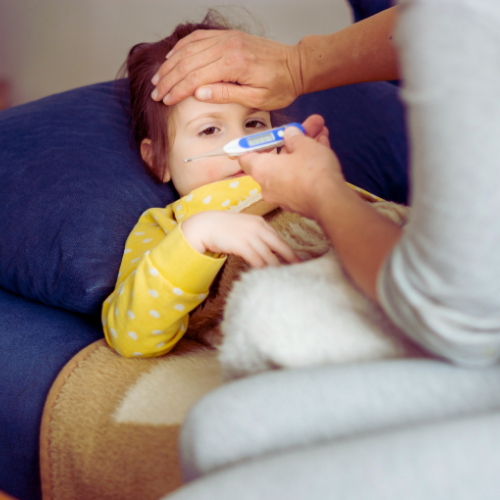
Our ability to generate fevers as a society is diminishing, which poses health risks. Cancer, for instance, thrives in a body with consistently low temperatures, caused by factors like excessive medication use and environmental pollutants.
Supporting the body’s natural healing processes, including fevers, is crucial. Homeopathic remedies, herbal teas, Jernigan Nutraceuticals remedies, and maintaining hydration can aid recovery without suppressing the fever. Specifically, the frequency-matched botanical formulas Microbojen™ and Virogen™ are specifically designed to match and support the energy the body is already generating to resolve viral and bacterial infections. They do not kill viruses and bacteria for the body like pharmaceuticals. They supercharge the body’s own wisdom and defense mechanisms to do what they were designed to do.
Recognizing and understanding the stages and types of fever can help parents support their children’s health effectively.
Pre-Fever
An important step to supporting your child when they get sick is watching for early signs that their body has something to work through. They will often start getting more moody and low-energy. They may have less of an appetite, a sore throat, swollen glands in the neck, and a slightly elevated temperature. When you start noticing these in your child, this is your cue to start clearing the schedule and gathering your supplies to give them time and support to process through the upcoming sickness.
Fever Response 1: Gradually Increasing Fevers
A fever that gradually increases usually indicated that it is responding to a BACTERIAL infection. In this case, supporting the fever process and allowing it to rise can be beneficial.
Fever Response 2: Sudden Onset Fevers
When a high fever comes about suddenly, it usually indicates that is responding to a VIRAL infection. In the case of a rapidly increasing temperature in response to a viral infection, the homeopathic Aconite napellus is one of the best remedies to administer to not reduce the fever, but rather, harness it and direct its anti-viral attack (1). Again, supporting the body’s natural processes is key, avoiding the use of anti-fever drugs unless advised by a doctor.
Fever Response 3: Weak (Around 99.0° to 100.5°)
If the child’s body is trying for a fever but seems to be struggling to achieve it fully, you may want to support its efforts by giving your child a warm bath, keeping their room warm, wrapping them in a peat/wool blend blanket.
The Biologix Center For Optimum Health On When a Fever Gets Beyond 102.5° F
“If the [bacterial-response] fever continues to progress beyond 102.5° F, then homeopathic silver 30x (Argentum) should be used to restrain the excessive fever process. Use 6-10 drops or pellets every fifteen minutes until fever breaks or stops rising. Although fevers much higher that this present no great danger in children they generally indicate that the organizational and restructuring efforts of the body are somewhat in need of greater control of the situation. Remember, an excessively high fever, such as 103.5° F or greater, does not mean that the bacterial infection is correspondingly bad, nor does it mean the infection is getting worse. The excessive fever indicates that the temperature regulating aspects of the body are set too high. (Homeopathic silver is not the same as colloidal silver, the latter will not achieve the same results, nor is the homeopathic silver being used to “kill” bacteria in this situation.) In this excessive fever condition, measures to assist in bringing down the body temperature can be used. Room temperature lemon juice and water compresses on the abdomen and calves, as well as tepid water enemas can help to disperse excessive heat.”